
The Cupboard Child
An essay on not giving up

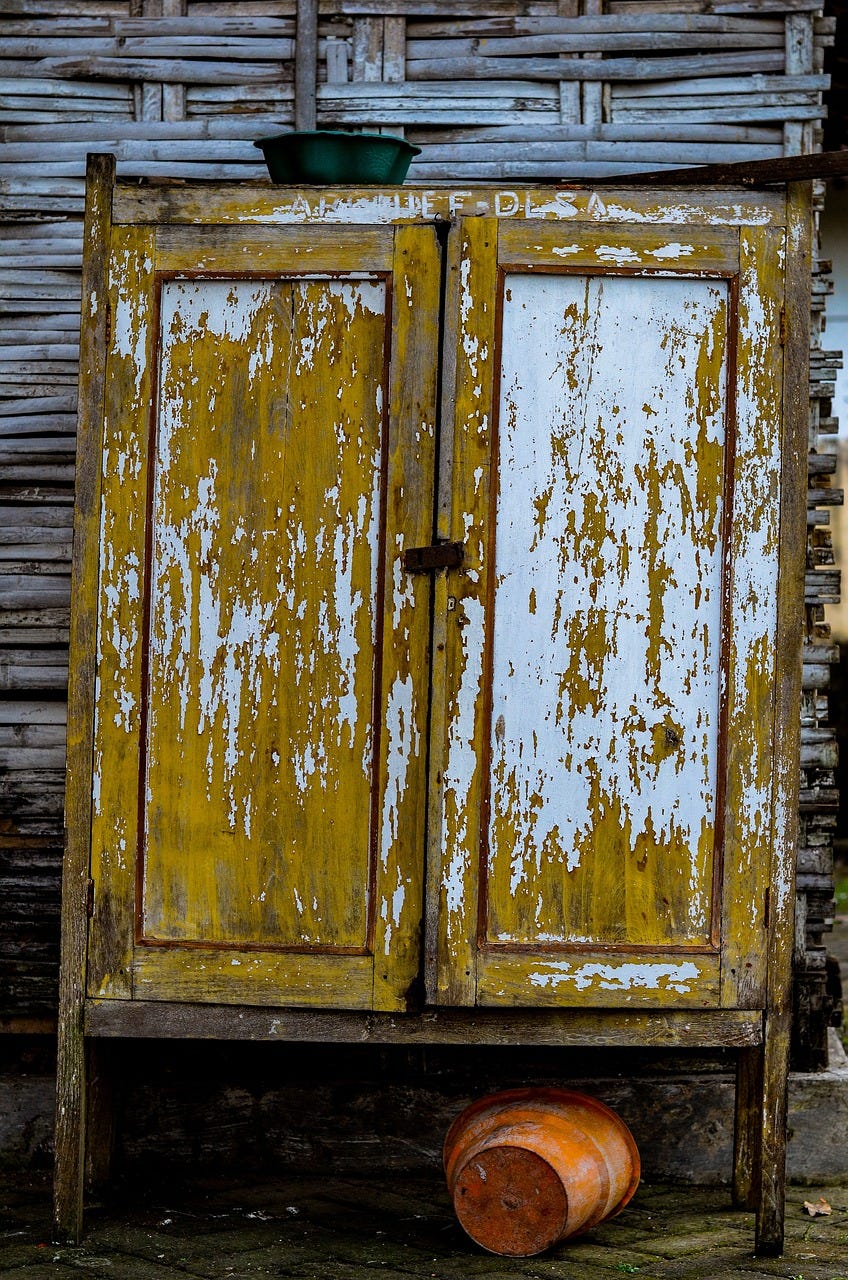
Photo credit: Dhitoardji from Pixabay
Once upon a time (ten years ago) I wrote my first manuscript. Dear Reader, I loved her. She came out in bits, in found moments, scrounged like change from sofa cushions (something still possible a decade ago, when people carried money and put it in their pockets.) She appeared, page by page, when I wasn’t working, parenting, socializing (a thing even I, as an introvert, did before the pandemic.) And when she came to an end, I knew she’d could, perhaps one day, be something. at the time, it only mattered that I had her, evidence of finally disregarding the lie that I didn’t have time, proof I had finally claimed the “I’m a writer” mantra I’d chanted, but done little about, since the age of three. (In fairness, the three year old only knew she loved stories. She didn’t know what it meant to be a writer. Don’t get the idea she was a savant, or anything.)
I made assumptions about First Manuscript. Loving her though I did, she had significant shortcomings. It wasn’t her fault she’d been born, as it were, to a young, ill-equipped Mum. So, rather like a naive storybook queen who had produced an heir, but the wrong sort, I hid her away. Her charms were apparent to me, but she wasn’t fit for polite society. Better, I thought, she remain, safe and adored, in a cupboard, Aside from the rare few who witnessed her birth (and were kind, but of like mind that she wasn’t the best I could do) I destined her to remain hidden away, a rarely told secret.
The writing continued and with it came the joy of continued writerly growth. Every effort teaches you something about your voice, your style. You try things on and cast them off. You play with ideas. Some land, some don’t, but still you learn and take the knowledge into each new project. And so, one a year, I’d take First Manuscript on outings. It wasn’t my intention so much to make her fit for public consumption as to play with her. Sometimes I’d apply one of my new tricks and she laughed and skipped. Sometimes she stood in awkward clothes I’d made her with a look of horror in her eyes. (One of the first-writer mistakes I made early on was taking every piece of writing “wisdom” as gospel instead of first considering whether it suited me. Sometimes, when I listened more to others than myself, I did some real damage to First Manuscript. Thankfully, she forgave me.) And I began to flirt with the idea that, perhaps, she might amount to something, although I usually talked myself out of such nonsense.
Five years later, I joined a writing group and we had the opportunity to submit a sample to a couple editors, all for the purpose of getting insight into how the editing process worked. I panicked. We were a small group, and though the submissions would be anonymous, we all knew one another’s genres. There wouldn’t be a ton of mystery about whose work was whose. To be clear, my panic didn’t owe to the free opportunity to be savaged by a professional editor but the chance that these women I liked, from whom I was learning so much, would bear witness to aforementioned savagery and decide I didn’t belong in their group.
So, I did a sneaky thing. I submitted some pages from Firstborn. (I had confessed her existence to the group.) The thinking ran that, after the editors had their way with her I could say, “Now you know why she lives in a cupboard” and regain whatever face I’d lost.
And so. Our samples were critiqued. valuable insights were gleaned, etc. But the editors didn’t rip apart my sample. They had very few notes, in fact. And during the session, one of my colleagues sent me a DM reading: “Is this the book you’re shopping around? Because if it’s not, it should be.”
And so, Firstborn came out of the cupboard once and for all. I lavished on her all the care and attention she deserved. I received useful critique from early readers, worked with a brilliant editor, and brought her into her fullness. And in another week or so, she will be out in the world as a real, honest-to-goodness book.
Sometimes projects truly don’t come together, and that is OK. Nothing is ever wasted. (More than once one of my murdered darlings has ended up quite happily in another project.) It is also OK to give a work—and yourself—time to bloom.
I love the life breathed into your first borne.
I read this absolutely RAPT. Every word sings — I love the way you describe her. It reminds me of my relationship with my Firstborn. (I only say that to express this feeling of connection and kinship). Thank you for freeing her — I look forward to reading (and loving) her. 🥲